 Acne.org Products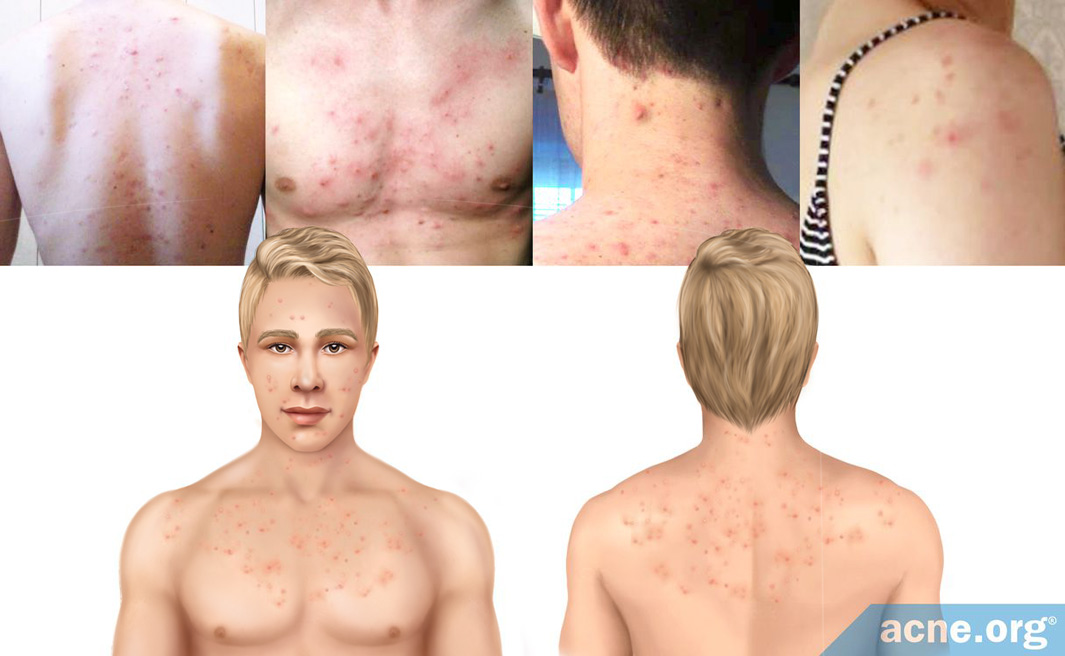
Information and Treatment Options

The Essential Info
It’s Common: More than half of people with facial acne also have some body acne.
Fewer, but More Severe Lesions: Body acne develops in a similar way as facial acne and has similar causes, but because the skin on the body contains fewer pores, we often see fewer lesions on the body compared to the face. However, because pores on the body tend to be larger than pores on the face, when lesions do develop, they are often larger and more severe.
Most Common on the Upper Body: Body acne can occur anywhere on the body other than the palms of the hands and soles of the feet, but shows up most often on the:
- Back
- Chest
- Back of the neck
- Shoulders
- Upper arms
Topical Treatment (Adequate for Most Cases): Treatment for body acne is similar to treatment for facial acne, but the skin on the body tends to be tougher than the skin on the face and can withstand more aggressive treatment. Proper application of 2.5% benzoyl peroxide + 10% glycolic acid normally does the trick.
Oral Treatment (For Severe, Widespread, and Scarring Body Acne): Despite its potential to cause long-term and severe side effects, doctors sometimes prescribe isotretinoin (Accutane®) for severe cases of body acne.

The Science
- Where Body Acne Forms
- Body Acne Is Common
- How It Develops
- Fewer, but More Severe Lesions
- What Causes It
- Irritation Can Make It Worse
- Avoiding Irritation
- Treating Body Acne
Where Body Acne Forms
Body acne normally occurs on the back, chest, back of the neck, shoulders, and upper arms, but can develop anywhere on the body except for the palms of the hands and soles of the feet, which are the only two areas that do not have skin pores (sebaceous follicles).
Body Acne Is Common
More than half of people who have facial acne also have some amount of body acne.1-3 However, because people normally wear clothing that ends up obscuring body acne from view, we often can’t see it.4
How It Develops
Body acne develops in a similar way to facial acne, when pores become clogged, and skin oil that normally drains to the surface gets trapped, allowing acne bacteria to overgrow.
Fewer, but More Severe Lesions
Because the skin on the trunk (back and chest) contains less pores per square inch than facial skin, we often see fewer lesions on the trunk than on the face. However, pores on the body are larger, which often makes the lesions that develop on the body more severe.5,6
Another reason we might see less acne on the body compared to the face is because skin on the body is more acidic.6 Acne bacteria prefer less acidic environments.
What Causes It
As with any type of acne, development of body acne requires:
- Hormones – Acne does not form until after puberty.
- Inflammation – Acne is primarily an inflammatory disease.
- Bacteria – Acne lesions normally contain an overgrowth of bacteria.
- Genetics – If your parents had acne, you’re more likely to suffer with it as well.
Other contributing factors may include:
- Stress – Research shows us that stress may lead to more acne.
- Diet – Some evidence is trickling in that eating low glycemic and keeping antioxidant levels high with lots of colorful vegetables and fruits may help.
- Vitamin Deficiency – Do low levels of vitamin D, zinc, or other vitamins lead to more acne? It could be part of the puzzle.
Irritation Can Make It Worse
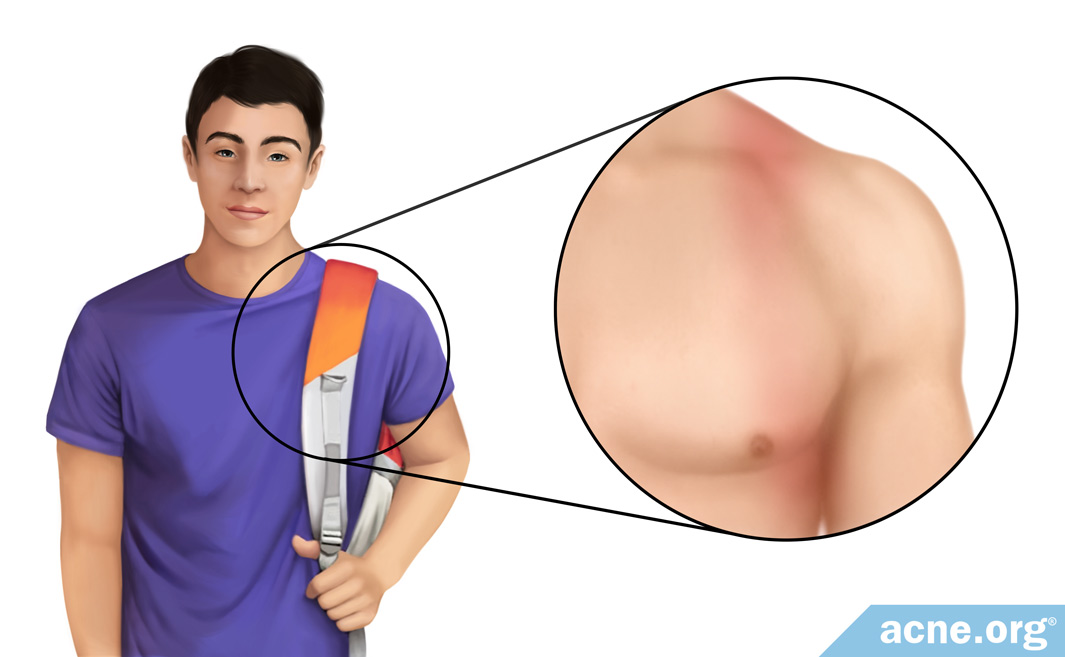
Importantly, physical irritation can make body acne worse. Anything that rubs against your skin can cause irritation. This is so well accepted in scientific literature that it has its own name, acne mechanica.
While sweat itself does not cause acne itself, sweat combined with irritation tends to make irritation worse.8,9
Avoiding Irritation
- Wear breathable cotton clothing when possible. If you get sweaty, try to change your clothing when you can.
- Time your workouts so that you can shower and treat your skin afterward.
- Generally try to be aware of what might be irritating your skin in areas where you break out regularly and make changes where you can.
Don’t worry too much! Our bodies are constantly in contact with various things and it is impossible to avoid irritation altogether. There is no need to obsess about avoiding irritation on the body. Rather, simply be aware of small changes you might be able to make and leave it at that.
Treating Body Acne
A Topical Benzoyl Peroxide + Glycolic Acid Regimen: The most effective topical treatment incorporates both 2.5% benzoyl peroxide and 10% glycolic acid. This powerful combination can clear up even tough-to-treat cases of body acne.
Accutane (isotretinoin): For severe, widespread, and potentially scarring acne, Accutane (isotretinoin) is an option. Isotretinoin is an oral medication that is normally prescribed for 15-20 weeks and produces long-term remission of acne symptoms in about 2/3 of people. However, it is powerful, and can permanently change the skin and the body. It comes with a long list of side effects, some potentially long-term and serious, including causing severe birth defects. For these reasons, it should never be entered into lightly, and must be administered in close partnership with your physician.
References
- Del Rosso, J. Prevalence of truncal acne vulgaris: A population study based on private practice experience. J. Am. Acad. Dermatol. 56, AB3 (2007). https://www.jaad.org/article/S0190-9622(06)02914-8/fulltext
- Tan JK, et al. Prevalence and severity of facial and truncal acne in a referral cohort. J. Drugs Dermatol. 7, 551-556 (2008). https://www.ncbi.nlm.nih.gov/pubmed/18561586
- Del Rosso, J. et al. A closer look at truncal acne vulgaris: prevalence, severity, and clinical significance. J. Drugs Dermatol. 6, 597-600 (2007). https://www.ncbi.nlm.nih.gov/pubmed/17668525
- Piccolo, D., et al. Effective intense pulsed light protocol in the treatment of moderate to severe acne vulgaris of the chest and back. The Journal of Clinical and Aesthetic Dermatology 15, 22-25 (2022). https://pubmed.ncbi.nlm.nih.gov/35342499/
- Mourelatos, K., Eady, E. A., Cunliffe, W. J., Clark, S. M. & Cove, J. H. Temporal Changes In Sebum Excretion And Propionibacterial Colonization In Preadolescent Children With And Without Acne. Br. J. Dermatol. 156, 22-31 (2007). https://www.ncbi.nlm.nih.gov/pubmed/17199562
- Kim, B.R., Chun, M.Y., Kim, S.A. & Youn, S.W. Sebum secretion of the trunk and the development of truncal acne in women: Do truncal acne and sebum affect each other? Dermatology 231, 87-93 (2015). https://www.ncbi.nlm.nih.gov/pubmed/26022281
- Kim, S.A., Kim, B.R., Chun, M.Y. & Youn, S.W. Relation between pH in the trunk and face: Truncal pH can be easily predicted from facial pH. Ann. Dermatol. 28, 216-21 (2016). https://www.ncbi.nlm.nih.gov/pubmed/27081270
- Short R.W., et al. A single-blinded, randomized pilot study to evaluate the effect of exercise-induced sweat on truncal acne. Pediatric Dermatology 25, 126-128 (2008). https://www.ncbi.nlm.nih.gov/pubmed/18304176
- Freiman, A., Benjamin, B. & David, J. E. Sports dermatology part 1: common dermatoses. CMAJ 171, 851-853 (2004). https://www.ncbi.nlm.nih.gov/pmc/articles/PMC522647/