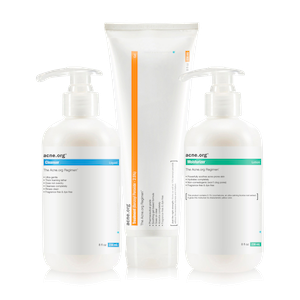
 Acne.org Products
What Is It?
Usually known by its brand name Epidu®, this topical treatment is a combination of adapalene, which is a type of medication called a retinoid that reduces inflammation in the skin and helps promote skin cell turnover, along with benzoyl peroxide, which kills acne bacteria and dries/peels the skin.
It is usually applied once a day before going to bed.
Results
Results
Strength of Evidence: Very Strong
Average 68% reduction in acne after 12 weeks
- Huang, P., Supan, O., Pak, C. L., Mehta, R. C. & Makino, E. T. Efficacy and Tolerability of a Novel Cosmetic and Over-the-Counter Facial Acne Regimen Versus a Prescription Treatment. J Cosmet Dermatol 24, e16568 (2025).
- Gold, M. et al. Efficacy and Safety of Clindamycin Phosphate 1.2%/Adapalene 0.15%/Benzoyl Peroxide 3.1% Gel: Post Hoc Analysis by Baseline Disease Severity. Dermatol Ther (Heidelb) 15, 1867–1882 (2025).
- Tempark, T., Shem, A. & Lueangarun, S. Efficacy of ceramides and niacinamide‐containing moisturizer versus hydrophilic cream in combination with topical anti‐acne treatment in mild to moderate acne vulgaris: A split face, double‐blinded, randomized controlled trial. J of Cosmetic Dermatology 23, 1758–1765 (2024).
- Pradhan, M., Prajapati, S., Bichchha, R. & Guragain, A. Comparative study on efficacy of benzoyl peroxide with adapalene versus plain adapalene in the treatment of acne vulgaris. Nepal Mediciti Medical Journal 5, 25–33 (2024).
- Lee, J.-H. et al. Investigation of the effect of adapalene 0.3%/benzoyl peroxide 2.5% gel in Korean patients with acne: a randomized, double-blind clinical trial, with a histopathological and immunohistochemical study. Ital J Dermatol Venereol 159, (2024).
- Batra, R. et al. Investigating the use of 0.3% adapalene/2.5% benzoyl peroxide gel for the management of moderate-to-severe acne in indian patients: A phase 4 study assessing safety and efficacy. Cureus https://doi.org/10.7759/cureus.65894 (2024) doi:10.7759/cureus.65894.
- Inbamani, A. P. D., Manickam, N. & Gopalan, K. Efficacy and tolerability of 0.1% adapalene with 1% clindamycin versus 0.1% adapalene with 2.5% benzoyl peroxide on acne vulgaris: A case control study. International Journal of Dermatology and Venereology 6, 20 (2023).
- Geetha, A., Vishaka, Raghav, M. V. & Asha, G. S. Indian Journal of Pharmaceutical Sciences. https://www.ijpsonline.com/ (2023).
- Draelos, Z. D., Baalbaki, N., Colon, G. & Dreno, B. Ceramide-containing adjunctive skin care for skin barrier restoration during acne vulgaris treatment. J Drugs Dermatol 22, 554–558 (2023).
- Stein Gold, L. et al. Efficacy and safety of a fixed-dose clindamycin phosphate 1.2%, benzoyl peroxide 3.1%, and adapalene 0.15% gel for moderate-to-severe acne: A randomized Phase ii study of the first triple-combination drug. Am J Clin Dermatol 23, 93–104 (2022).
- Rocha, M. A. D. da, Schalka, S., Bayan, F. C., Yoshizumi, T. H. C. B. M. & Blum, V. F. The Efficacy of an Oral Probiotic Associated with a Fixed Combination of Benzoyl Peroxide and Adapalene in the Treatment of Acne: A Randomized, Double-Blind, Placebo-Controlled Clinical Trial. https://www.researchsquare.com/article/rs-2227654/v1 (2022) doi:10.21203/rs.3.rs-2227654/v1.
- Patel, R. R. & Karelia, B. N. A study of effectiveness and safety of topical combination therapy for acne vulgaris patients in dermatology department of a tertiary care teaching hospital. http://imsear.searo.who.int/handle/123456789/200551 (2020).
- Zheng, Y. et al. Efficacy and safety of 2% supramolecular salicylic acid compared with 5% benzoyl peroxide/0.1% adapalene in the acne treatment: a randomized, split-face, open-label, single-center study. Cutan Ocul Toxicol 38, 48–54 (2019).
- Tan, J., Bissonnette, R., Gratton, D., Kerrouche, N. & Canosa, J. M. The safety and efficacy of four different fixed combination regimens of adapalene 0.1%/benzoyl peroxide 2.5% gel for the treatment of acne vulgaris: results from a randomised controlled study. Eur J Dermatol 28, 502–508 (2018).
- Ghosh, A. & Das, K. Efficacy and safety of nadifloxacin and benzoyl peroxide versus adapalene and benzoyl peroxide in acne vulgaris: A randomized open-label Phase IV clinical trial. Journal of Pharmacology and Pharmacotherapeutics 9, 27–27 (2018).
- Dréno, B. et al. Prevention and reduction of atrophic acne scars with adapalene 0.3%/benzoyl peroxide 2.5% gel in subjects with moderate or severe facial acne: results of a 6-month randomized, vehicle-controlled trial using intra-individual comparison. Am J Clin Dermatol 19, 275–286 (2018).
- Dreno, B., Tan, J., Rivier, M., Martel, P. & Bissonnette, R. Adapalene 0.1%/benzoyl peroxide 2.5% gel reduces the risk of atrophic scar formation in moderate inflammatory acne: a split-face randomized controlled trial. J Eur Acad Dermatol Venereol 31, 737–742 (2017).
- Bouloc, A. et al. A skincare combined with combination of adapalene and benzoyl peroxide provides a significant adjunctive efficacy and local tolerance benefit in adult women with mild acne. J Eur Acad Dermatol Venereol 31, 1727–1731 (2017).
- Alexis, A. F., Cook-Bolden, F. E. & York, J. P. Adapalene/benzoyl peroxide gel 0.3%/2.5%: a safe and effective acne therapy in all skin phototypes. J Drugs Dermatol 16, 574–581 (2017).
- Stein Gold, L., Weiss, J., Rueda, M. J., Liu, H. & Tanghetti, E. Moderate and severe inflammatory acne vulgaris effectively treated with single-agent therapy by a new fixed-dose combination adapalene 0.3 %/benzoyl peroxide 2.5 % gel: a randomized, double-blind, parallel-group, controlled study. Am J Clin Dermatol 17, 293–303 (2016).
- Jawade, S. A., Saigaonkar, V. A. & Kondalkar, A. R. Efficacy and tolerability of adapalene 0.1%-benzoyl peroxide 2.5% combination gel in treatment of acne vulgaris in indian patients: a randomized investigator-blind controlled trial. Iranian Journal of Dermatology 19, 105–112 (2016).
- Sittart, J. A. de S. et al. Multicenter study for efficacy and safety evaluation of a fixeddose combination gel with adapalen 0.1% and benzoyl peroxide 2.5% (Epiduo® for the treatment of acne vulgaris in Brazilian population. An Bras Dermatol 90, 1–16 (2015).
- Abhinaya, J., Sudar Codi, R., Yuti, N. & Manimekalai, K. Comparison of the efficacy and safety of topical 1% clindamycin with 0.1% adapalene and 2.5% benzoyl peroxide with 0.1% adapalene in the treatment of mild to moderate facial acne vulgaris: a randomized prospective study. International Journal of Current Research 7, 17457–17460 (2015).
- Tabasum, H., Ahmad, T., Anjum, F. & Rehman, H. The effect of Unani antiacne formulation (Zimade Muhasa) on acne vulgaris: A single-blind, randomized, controlled clinical trial. Journal of Pakistan Association of Dermatologists 24, 319–326 (2014).
- Eichenfield, L. F. et al. Preadolescent moderate acne vulgaris: a randomized trial of the efficacy and safety of topical adapalene-benzoyl peroxides. J Drugs Dermatol 12, 611–618 (2013).
- Gonzalez, P., Vila, R. & Cirigliano, M. The tolerability profile of clindamycin 1%/benzoyl peroxide 5% gel vs. adapalene 0.1%/benzoyl peroxide 2.5% gel for facial acne: results of a randomized, single-blind, split-face study. J Cosmet Dermatol 11, 251–260 (2012).
- Tan, J., Gollnick, H. P. M., Loesche, C., Ma, Y. M. & Gold, L. S. Synergistic efficacy of adapalene 0.1%-benzoyl peroxide 2.5% in the treatment of 3855 acne vulgaris patients. J Dermatolog Treat 22, 197–205 (2011).
- NCT01188538. Anti propionibacterium(p.) acnes activity of Epiduo® gel compared to benzoyl peroxide (bpo) 2.5% gel. (2011).
- Zouboulis, C. C., Fischer, T. C., Wohlrab, J., Barnard, J. & Alió, A. B. Study of the efficacy, tolerability, and safety of 2 fixed-dose combination gels in the management of acne vulgaris. Cutis 84, 223–229 (2009).
- Pariser, D. M. et al. Long-term safety and efficacy of a unique fixed-dose combination gel of adapalene 0.1% and benzoyl peroxide 2.5% for the treatment of acne vulgaris. J Drugs Dermatol 6, 899–905 (2007).
- Capizzi, R., Landi, F., Milani, M. & Amerio, P. Skin tolerability and efficacy of combination therapy with hydrogen peroxide stabilized cream and adapalene gel in comparison with benzoyl peroxide cream and adapalene gel in common acne. A randomized, investigator-masked, controlled trial. Br J Dermatol 151, 481–484 (2004).
Side Effects
Side Effects
Low-medium side effects and adverse reactions
Acne.org's Real World Take
A way of using benzoyl peroxide in combination with the topical retinoid, adapalene, that studies show works a bit better than benzoyl peroxide alone. Comes with side effects for the first weeks and can bleach fabric. Note: When used correctly, benzoyl peroxide on its own can completely clear the skin.
Reviews
3.7
496 Reviews