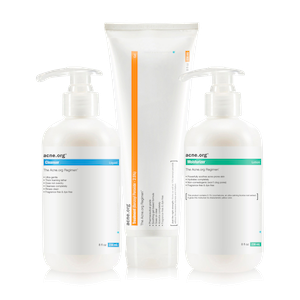
 Acne.org Products
The list of ingredients above is provided for informational purposes only. Always check the actual product label in your possession for the most accurate ingredient information due to product changes or upgrades that may not yet be reflected on our web site.

December 12, 2016
Hempseed Oil is Amazing!
I have been on the Regimen for years, it is the first thing that kept my skin mostly breakout free, ever. ( thank you Dan) I am 51 and thought I would grow out of acne years ago. I found too much of the jojoba oil would break me out, so I looked for other oils. Olive, coconut, shea butter,all were terrible. Then I tried hemp oil and it was magic. I finally dared to give up the Regimen and try using only Hempseed oil. I could not believe it, works even better than the Regimen. It is green and I don't like the smell, but it is not too bad. I think it works because it is 0 on the comedogenic scale and it is a high linoleic acid oil. After this was working well, I read about pumpkin seed oil and tried that. No go. Pimples after 2 days. The Hempseed oil cleared them up in a couple of days. Can't believe it took almost 40 years to find such a simple solution to a lifelong problem.

October 9, 2021
Works great for me… if it’s done right
I’ve been doing OCM for about 6 months now, and it is the best thing I’ve ever used for my acne. I am basically clear most of the time now, with only a very mild breakout mid-cycle that lasts for a couple days. I’ve been able to stop all my other much more expensive acne products, because OCM does better by itself than all of them put together. I’ve been battling acne on and off for almost 20 years at this point, and this is the best results with the least side effects that I’ve ever gotten from anything. I don’t know why this method seems so polarizing, but I have found that how I do it is very important, so I’ll share that in detail.
Firstly, to fill in a few details: I’m a woman in my 30’s, oily and slightly dehydrated skin that is, of course, acne-prone. I get both cystic and inflammatory acne that seems to rise and fall over the years like some nefarious tide. The last couple years the “tide” has been high, and I’ve had a lot of trouble with it. The previous treatments I was using reduced my cystic acne down to “occasional,” but I still had constant small inflammatory pimples along my cheekbones. Both are now essentially gone, post-OCM. I get the occasional random zit, again, mostly mid-cycle, but that’s it, and they’re pretty superficial. I do not use any other product on my face — not even a face wash, as I’ve found they tend to exasperate my acne for whatever reason. On in-between days, where I don’t do OCM, I just rinse with warm water and dry to help remove excess oil, and that’s it.
Ok, to the OCM part. I think something a lot of people don’t realize is that some oils are more irritating or more comedogenic than others. Most really bad experiences seem to be related to using olive oil or coconut oil. Neither of these are a good choice for acneic skin.
My blend is:
80% grape seed oil
10% castor oil
10% tamanu oil
Highly sensitive people may want to try eliminating the castor oil completely. For me, 10% seems to work fine.
I also don’t do it every day — only about once every 3 days. I think that doing it too much can cause dryness or irritation for a lot of people. Your perfect schedule might be a little different from mine.
Also, you don’t need much. I use a dime-sized amount and massage it into my face for about 20 or 30 seconds. It’s a pretty thin layer. My face doesn’t look all that oily — if I left the house like that on a warm summer day, no one would think I look unusual.
And finally, it’s REALLY important to wipe it all off with a wet washcloth. The water doesn’t have to be super hot or anything. I just use warm, because hot water can dry out your skin a lot more. But you need to wipe thoroughly — do a couple passes. Call it your exfoliation for the day. I always just brush my fingers around my face real quick once I’m done wiping and drying, to make sure I don’t feel any oily patches left over.
But also, I think part of the problem some people are having is that they’re getting bad advice about what to do when something clearly isn’t working for you. You don’t “purge” from OCM. In fact, you don’t purge from ANYTHING except retinoids. If you start this regimen and you start getting acne in unusual patterns that you normally don’t, stop. Either something you’re doing isn’t working, or the method itself isn’t right for you. Don’t just keep pushing forward until you’re having the worst breakout of your life. Don’t let people talk you into ignoring your body. Nothing works for everyone and I’m sure this won’t either, but I think a lot of these really terrible horror stories could be avoided by going with your gut on what’s good for you.

May 26, 2018
Incredible if you have allergies (seasonal or otherwise)
As someone with moderate to severe acne since I was a teenager (and now I'm 37) I was terrified to put straight unrefined organic coconut oil on my skin, but here's my reasoning: Coconut oil is 1) antibacterial, antiviral, antifungal.. 2) Visibly attaches to and removes makeup. 3) Doesn't interfere with the "acid mantle" of the skin, so it leaves your skin to protect itself (everyone has an acid mantle that is slightly acidic to naturally kill bacteria.. It's striped away by using soap which not only removes your protective layer but also is alkaline) 3) Is free from chemicals. A few weeks before I tried oil cleansing my skin was out of control. It had never been so oily in my life, which is saying something. It was chronically broken out with deep cysts and whiteheads. I was using witch hazel and alcohol on it several times per day just to get it to feel clean for a bit. I decided to try just using water in the evenings instead after reading several articles and the results were nothing short of miraculous! My zits dried up and FELL OFF!! This has NEVER happened to me. My skin was also no longer chronically bright red and irritated, and had taken on a soft, porcelain glow. BUT I could SMELL MY FACE. Yuck. I looked better, but having a sharp nose, even right after using warm water and a wash cloth to clean in the morning and evening, I could smell skin oils that grossed me out. THAT'S when I took the leak and tried oil cleansing. My Routine: Take a white washcloth (dye free and can be bleached in the wash to sterilize it), Run tolerably warm water over it and let it sit on my face and neck for about 30 seconds. Rub coconut oil on my face and neck gently and allow it to sit for at least a full minute. Use the washcloth with fresh, warm water to thoroughly but gently remove the oil (your face won't feel squeaky clean until you dry it.) Dry my face with a clean white cloth. * I DO THIS ONCE TO TWICE PER WEEK AND USE HONEY ON THE OTHER 5 DAYS WITH THE SAME ROUTINE EXCEPT PAPER TOWELS INSTEAD OF CLOTH BECAUSE... ANTS ;) The honey is even gentler than the oil, thus keeps my acid mantle completely in tact, protecting me from acne causing bacteria. My results: My skin glows and has vastly improved (at this moment I have 2 hormonal zits compared to a rash of zits across my chin, neck and forehead before). My face smells beautiful, like a tropical island or honey on the days that I use that. Additional reasons that this worked for me: I have always had combination skin that I blamed on hormones. While they are part of the problem, it turns out that I have sensitive skin too. If you have seasonal allergies, occasionally break out in hives or have chronically pink or red irritated cheeks you too could have sensitive skin. The traditional soaps and cleansers (even the organic products) strip your face of its natural defenses. This has been a miracle and a revelation for me to find after all of these years that less really is more. Within 3 days of using just water on my face in the evenings I was SHOCKED to solve the puzzle that is my face. I know that not everyone will have the same results so maybe just start off with your regular soap in the morning and then a wet, warm cloth with only water in the evenings and see how your skin responds. If there's a noticeable difference SLOWLY work your way to oil cleansing by trying the honey cleanse in the morning and water before bed for a few days. IF that seems to be improving things then try the coconut oil. I hope that this works for you too!! Love and light!!

October 20, 2016
OCM removed loads of my whiteheads in a week
I have been using OCM with sunflower oil and olive oil (no castor oil) and it was worked wonders for my whiteheads. I will be experimenting with castor oil soon. I definitely recommend this cleansing method.